
our Blog
French Drain vs. Catch Basin: Which Drainage Solution Does Your DFW Property Need?
French Drain vs. Catch Basin: Which Drainage Solution Does Your DFW Property Need?
Standing water in a DFW yard is one of those problems that seems straightforward to diagnose but frequently receives the wrong solution. The two most common drainage infrastructure options — French drains and catch basins — are often confused for interchangeable alternatives when they actually address different aspects of the drainage problem. Installing the wrong one doesn't just fail to solve the problem; it can create new complications while the original issue persists.
For homeowners throughout Fort Worth, Southlake, Keller, Colleyville, Grapevine, Trophy Club, Flower Mound, Highland Village, Lewisville, Frisco, Richardson, Plano, Allen, McKinney, Wylie, Rowlett, and the broader DFW area, understanding the specific problem each solution addresses makes the difference between drainage infrastructure that works and drainage infrastructure that disappointed.
Understanding What Each System Does
French drains are subsurface systems — underground perforated pipe surrounded by gravel and wrapped in filter fabric, designed to collect groundwater that has already entered the soil and redirect it away from the problem area before it reaches the surface or migrates toward the foundation. They work on water that is moving through the soil, not water that has accumulated on the surface.
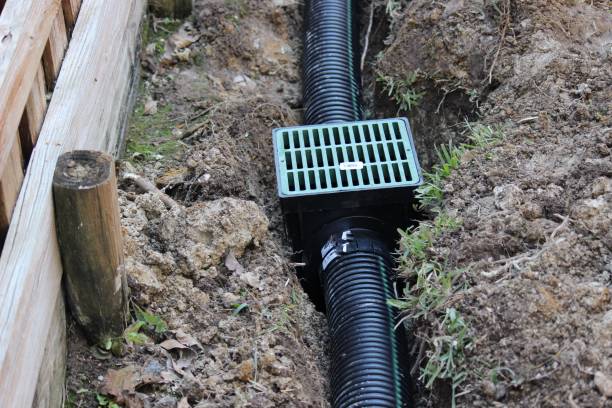
Catch basins are surface collection systems — underground boxes with surface grates that capture water flowing across the ground surface and route it through connected underground pipe to an appropriate discharge point. They work on water that is flowing or pooling at ground level, not water that is moving through the soil.
The distinction sounds technical but has practical implications that are immediately visible in DFW drainage situations.
The Problem French Drains Solve
French drains address the specific drainage failure mode that DFW's clay soil creates most frequently: the inability of the soil to absorb and transmit groundwater fast enough to prevent saturation in specific areas.
What French drains are designed for in North Texas:
Persistently soggy or spongy turf areas that remain wet for days after rain has ended — particularly areas that stay wet even when no rain has fallen recently. This pattern indicates groundwater is at or near the surface — rising from below or migrating laterally through the soil from adjacent higher ground.
Subsurface moisture migration toward the foundation. On DFW clay, groundwater moves laterally through the soil matrix after heavy rain events — migrating toward lower elevations and accumulating adjacent to foundations where it maintains the saturation pressure that drives slab movement. A French drain intercepting this lateral migration before it reaches the foundation is the most direct subsurface protection available.
Yards where the water table rises seasonally to near-surface levels. Properties near Lake Ray Hubbard in Rowlett, near Grapevine Lake in Trophy Club and Flower Mound, and in other DFW communities adjacent to significant water bodies sometimes experience seasonal groundwater rise that produces surface saturation even without recent rainfall. French drains address this condition by providing an active drainage path for the elevated groundwater.
Low-lying areas where soil saturation persists because the natural drainage path is inadequate for the clay's slow absorption rate. This is very common in DFW neighborhoods on flat lots where the natural grade doesn't provide enough slope for surface water to exit the property quickly.
How French drains work: The perforated pipe in gravel is installed below the problem zone, at a depth that intercepts the groundwater movement. Water in the soil seeps through the gravel and enters the perforated pipe through the perforation holes. The pipe carries it by gravity to a discharge point — typically a pop-up emitter, a storm drain connection, or an appropriate outlet at the property boundary.
The Problem Catch Basins Solve
Catch basins address a different failure mode: the accumulation of surface water that arrives faster than it can be absorbed or that has nowhere to drain from a collection point.
What catch basins are designed for in North Texas:
Hardscaped low points where water has nowhere to drain. Driveways with low centers, patio areas adjacent to the house, concrete aprons at garage entries where water pools during heavy rain — these are catch basin situations because the water is on the surface and needs to be captured at the collection point before it can migrate toward the foundation.
Natural low spots in lawn areas that collect surface runoff from multiple directions. A backyard depression that receives surface flow from multiple adjacent higher areas during rain events — but is surrounded by clay soil that absorbs water too slowly to prevent standing water — is a catch basin candidate. The water arrives at the surface from multiple directions and needs to be captured at the low point and routed underground.
Swimming pool decks and patios where splash and rain accumulation needs directed drainage. Surface water on hardscaped areas needs collection points — linear channel drains at the low edge of a patio or catch basins at the low corner of a pool deck — that capture water flowing across the surface before it migrates toward the foundation or the building structure.
Driveway drainage problems where the driveway surface collects water that has no outlet except toward the garage entry or back toward the street. Channel drains across the driveway width or catch basins at the low point capture this flow and route it underground.
How catch basins work: A precast concrete or plastic basin box is installed at the collection point with the top grate at or slightly below grade. Surface water flowing toward the collection point enters the grate, accumulates in the basin, and exits through a connected underground pipe routed to an appropriate discharge point. The pipe is solid (not perforated), sized for the expected flow volume.
The Cases Where Both Are Needed
Many DFW properties have drainage problems that involve both surface accumulation and subsurface saturation — and these properties need both systems working together.
Example: A west Fort Worth property with a backyard area that stays soggy for three to four days after significant rain. The homeowner observes both standing water visible on the surface during rain events and persistently soft, spongy turf that remains after the standing water eventually drains.
This property has two distinct problems:
- Surface water accumulation during rain events that collects at the low point faster than it can drain (catch basin problem)
- Subsurface groundwater saturation in the clay that persists after surface water has dispersed (French drain problem)
Installing only a catch basin addresses the standing water during rain events but doesn't address the subsurface saturation that keeps the turf soggy for days afterward. Installing only a French drain addresses the subsurface saturation but doesn't capture the surface accumulation during active rain events.
Quinn Gutters encounters this combined situation regularly in DFW — particularly in established neighborhoods where mature landscaping, flat lot grades, and decades of soil settling have created drainage conditions that a single system type can't fully address. The assessment process identifies which combination of systems is appropriate for each specific property.
How Quinn Gutters Decides Which System to Recommend
The field assessment question that drives Quinn Gutters' drainage recommendation is straightforward: when does the problem occur, and where does the water come from?
If the problem is worst during rain events and subsides within hours afterward: Surface accumulation is the primary driver — catch basins at the collection points, with connected underground pipe to appropriate discharge.
If the problem persists for days after rain has stopped, even in areas well away from rain collection points: Subsurface groundwater is the primary driver — French drain installation at appropriate depth to intercept the water movement through the soil.
If both patterns are present: Combined system with catch basins for surface collection and French drains for subsurface management, integrated into a shared outlet network where the property layout permits.
If the problem is specifically downspout discharge creating concentrated moisture at the foundation: Neither a French drain nor a catch basin is the primary solution — underground downspout extensions with pop-up emitters address the specific source. French drains may be added if subsurface saturation is also occurring, but the downspout discharge issue should be corrected first because it's the primary moisture source.
Installation Considerations for DFW Properties
Pipe routing for French drains: DFW clay requires careful attention to pipe slope and discharge point selection. The pipe must maintain consistent grade for reliable gravity flow — typically 1 percent or more — which requires assessment of the available elevation change from the collection zone to the potential outlet.
Filter fabric quality: French drain longevity in DFW clay depends critically on the quality of the geotextile filter fabric wrapping the gravel. Clay particles are extraordinarily fine, and fabric that allows fine clay migration into the gravel layer will produce a failed system within 5 to 10 years as the gravel voids fill with clay. Quinn Gutters uses appropriate fabric specifications for DFW's fine-particle clay.
Catch basin sizing: Basin boxes must be sized for the anticipated inflow volume. A basin that's too small backs up during intense rain events rather than capturing the full surface flow. Quinn Gutters sizes basins for each application based on the drainage area contributing to each collection point.
Discharge point selection: Both French drain outlets and catch basin pipe outlets must discharge at appropriate locations — on permeable soil that can absorb the flow, at adequate distance from the foundation, and within the property boundary. Quinn Gutters assesses discharge options during the site evaluation and designs outlet placement that meets these requirements.
Quinn Gutters: Full Drainage Solutions Across DFW
Quinn Gutters installs French drain systems, catch basin systems, combined drainage networks, and underground downspout extensions for homeowners throughout the full DFW service area — Fort Worth, Southlake, Keller, Colleyville, Grapevine, Trophy Club, Flower Mound, Highland Village, Lewisville, Frisco, Richardson, Plano, Allen, McKinney, Wylie, Rowlett, and surrounding communities.
Every drainage recommendation starts with an honest property-specific assessment that identifies which problem the water is creating — surface, subsurface, or both — and recommends the system combination that actually addresses the identified problem rather than the most common default solution.

Find Out Which Drainage Solution Your DFW Property Actually Needs
Request your free drainage assessment from Quinn Gutters today and get the honest, property-specific recommendation that your North Texas yard actually needs.


