
our Blog
How DFW's Bradford Pear Trees Destroy Gutters — And What to Do About It
If you own a home in Flower Mound, Southlake, Keller, or virtually any established DFW neighborhood that was developed between the 1980s and early 2000s, there's a good chance you have Bradford pear trees somewhere on or near your property. These ornamental trees became the dominant landscaping choice for suburban development across North Texas for nearly two decades — planted in medians, front yards, and neighborhood common areas throughout the metroplex.
Bradford pears bloom dramatically in early spring — beautiful clusters of white blossoms that make neighborhoods look stunning for about two weeks. And then those blossoms fall. All at once. Into your gutters.
For DFW homeowners, Bradford pear blossom season is one of the most consistent and most destructive gutter clogging events of the entire year — and it happens right as spring storm season is beginning to ramp up. This guide explains the specific threat Bradford pears pose to gutter systems throughout the DFW area and what homeowners can do about it.
The Bradford Pear Problem: Why Blossoms Are Worse Than Leaves
Most homeowners think of fall leaf drop as the primary gutter debris challenge. In DFW neighborhoods with significant Bradford pear populations, spring blossom fall is often the more damaging event — and it's one that catches homeowners off guard because it doesn't fit the standard mental model of "leaves clog gutters."
Why Bradford pear blossoms are particularly problematic:
Bradford pear blossoms are small, numerous, and wet. When they fall in early March — typically during the same weather conditions that bring spring rainfall — they don't behave like dry leaves that can be blown out with a cleaning visit. They absorb water and compact into dense, sticky masses that conform to the shape of the gutter channel and pack against downspout inlets with remarkable effectiveness.
A single Bradford pear in full bloom over a gutter can deposit enough blossom material in a two-week period to partially or fully block a 5-inch gutter channel. Multiple Bradford pears on a property — which is common in neighborhoods from the development era when these trees were ubiquitous — can completely pack gutters within days.
The timing problem:Bradford pear blossom fall in the DFW area occurs in mid-February through mid-March — right at the onset of spring storm season. Gutters that are packed with wet blossom material heading into the first significant spring storms of the year are gutters that will overflow during those storms. And in North Texas, those first spring storms often bring the most intense rainfall of the year.
This creates the most dangerous gutter situation possible: maximum debris load arriving at precisely the same time as maximum rainfall demand, before most homeowners have scheduled their spring cleaning visit.
The Second Problem: Bradford Pear Fruit and Summer Shedding
Bradford pear trees are also prolific producers of small fruit — typically produced in spring and ripening in late summer and early fall. These small berries drop in enormous quantities and, like the blossoms, are small and dense enough to compact effectively in gutter channels. Properties with multiple mature Bradford pears may experience significant fruit drop from August through October that adds to the debris challenge of fall leaf drop season.
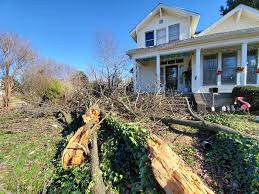
Additionally, Bradford pears are notoriously structurally weak trees that suffer significant branch failure during North Texas wind events. Storm-driven branch debris from Bradford pears is common in DFW neighborhoods after any significant spring storm — adding physical debris loads on top of the biological debris challenge.
The DFW Communities Most Affected
The communities most heavily impacted by Bradford pear gutter problems are those that experienced substantial residential development between approximately 1985 and 2005 — the peak Bradford pear era for North Texas landscaping:
Flower Mound's established neighborhoods like Bridlewood and Stone Hill Farms. Southlake's older communities that predate the current development wave. Keller's established neighborhoods throughout the Hidden Lakes and Bear Creek areas. Colleyville's mature residential corridors. Parts of Trophy Club, Grapevine, and other mid-development era communities throughout Tarrant and Denton Counties.
Any neighborhood where you see Bradford pear trees blooming white along the streets in March is a neighborhood where gutter blossom clogging is a consistent annual challenge.
What Bradford Pear Blossom Clogging Does to Your DFW Home
Overflow during early spring storms:The most immediate consequence of Bradford pear blossom clogging is overflow during the first significant spring storm events. DFW spring storms that arrive while gutters are packed with blossom material create the overflow-against-foundation scenario that drives clay soil moisture cycling and foundation risk.
Damage hidden until later:Blossom material that packs into downspout inlets during March may not produce visible overflow immediately — the overflow risk may not materialize until a heavy April or May storm hits what appears to be a clean channel but has a hidden downspout blockage from compacted blossom debris below the visible gutter level.
This hidden blockage pattern is one of the reasons Quinn Gutters' spring cleaning service specifically includes downspout flushing — because the most dangerous blockage is the one you can't see from the ladder while clearing the channel.
Wet blossom material and fascia contact:Wet blossom masses that accumulate behind the gutter and against the fascia during rain events maintain moisture contact with the fascia board continuously while the material remains — accelerating the moisture absorption that drives fascia deterioration.
Solutions for Bradford Pear Gutter Problems
Early spring cleaning — timing is everything:For DFW homeowners with Bradford pears near the roofline, scheduling a professional gutter cleaning immediately after bloom fall — typically mid-March in the DFW area — is the most important single scheduling decision of the year. The window between bloom fall completion and the first major spring storms is often narrow, and cleaning within that window is the difference between a functioning system and an overflowing one during the first significant rain.
Quinn Gutters provides spring cleaning for Flower Mound, Southlake, Keller, Colleyville, and all DFW communities on a schedule that addresses this Bradford pear window specifically.
Gutter guards designed for fine debris:Standard mesh gutter guards with openings large enough to pass Bradford pear blossoms don't solve the Bradford pear problem — they just let the blossoms into the channel where they compact as usual. Effective Bradford pear guard solutions use micro-mesh systems with openings fine enough to block blossom material while allowing water through.
Quinn Gutters assesses the specific debris profile of each property before recommending guard systems — recognizing that Bradford pear-dominated debris environments require finer filtration than standard leaf-dominated environments. The right micro-mesh guard on a Bradford pear-heavy property can transform a four-cleanings-per-year maintenance burden into once-annual inspection.
Tree management:For homeowners dealing with severe Bradford pear debris loads, the most permanent solution is tree management — either significant trimming of branches that overhang the roofline or, in severe cases, tree removal. Bradford pears are structurally weak enough that mature specimens frequently fail during North Texas storms anyway — proactive removal is often the right decision both for gutter protection and general safety.
Underground downspout extensions:Ensuring downspout discharge is well away from the foundation is particularly important for homes with Bradford pear trees — because the overflow risk during blossom season is at its highest right at the start of spring storm season when foundation moisture cycling risk is also at its peak.
Quinn Gutters: Understanding DFW's Specific Debris Challenges
Quinn Gutters serves homeowners throughout Fort Worth, Flower Mound, Southlake, Keller, Colleyville, Grapevine, Trophy Club, Highland Village, Lewisville, Northlake, Argyle, and surrounding DFW communities with gutter services designed around the specific debris challenges of North Texas — including the Bradford pear problem that affects so many established neighborhoods throughout the area.
Our cleaning service is timed to the DFW debris calendar — not a generic twice-annual schedule applied to every property regardless of local conditions. Our gutter guard recommendations account for the specific debris types each property faces — including fine blossom material that requires finer filtration than standard leaf debris.

Solve Your Bradford Pear Gutter Problem for Good
Request your free assessment from Quinn Gutters today and let our team evaluate your Bradford pear situation and recommend the right combination of cleaning, guards, and drainage to protect your DFW home through every spring blossom season.


