our Blog
How Gutter Problems Silently Damage Your DFW Home for Years Before You Notice
How Gutter Problems Silently Damage Your DFW Home for Years Before You Notice
The most expensive gutter-related damage in DFW homes doesn't announce itself. It doesn't produce sudden, dramatic water events that require immediate response. It accumulates quietly — behind the fascia, inside the wall cavity, in the clay soil immediately adjacent to the foundation — through repeated small exposures over multiple seasons, each individually unremarkable, collectively significant.
By the time the damage becomes visible — staining on interior ceilings, doors that suddenly stick in summer, wall cracks that appear without an obvious cause — the process that produced those symptoms has typically been underway for two to three years. The homeowner is seeing year three of a problem that started in year one.
For homeowners throughout Fort Worth, Southlake, Keller, Colleyville, Grapevine, Trophy Club, Flower Mound, Highland Village, Lewisville, Frisco, Richardson, Plano, Allen, McKinney, and the broader DFW area, understanding the specific mechanisms of silent gutter damage — and the timeline over which it progresses — is the most compelling argument for proactive gutter management rather than reactive response.
Silent Damage Zone 1: The Fascia
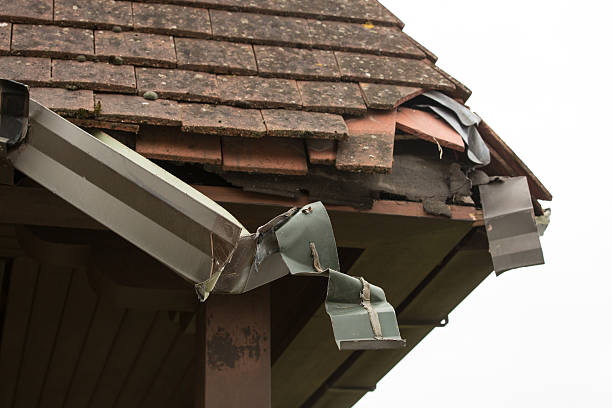
Fascia deterioration from gutter failure is the silent damage process that Quinn Gutters most frequently encounters in established DFW neighborhoods — and it's among the most economically significant because of what it costs to correct and the constraint it creates on future gutter work.
The mechanism: When a gutter joint fails at the rear of the channel — directing water against the fascia board rather than toward the downspout — the fascia absorbs moisture with each rain event. A single contact isn't meaningful. Repeated contact through 10 to 15 significant rain events during a spring season is.
After one spring season of joint failure: The fascia has absorbed moisture from repeated contact. Paint on the fascia face begins losing adhesion from beneath — the first sign of the underlying moisture absorption. The wood itself is still structurally sound.
After two spring seasons: Paint failure is visible if you look closely at the fascia behind the gutter. The wood has absorbed enough moisture through two wet seasons to begin the softening process. A gentle press reveals slightly reduced firmness compared to undamaged sections.
After three spring seasons: The fascia at the joint location is actively soft — the structural integrity that holds gutter hangers is compromised. Any hanger in this section is now in a deteriorating mounting surface. New hangers installed in this section would begin pulling loose within months.
Why it's silent: The fascia is hidden directly behind the gutter channel. There's no way to observe its condition without either removing the gutter or getting close enough with a ladder to look at the contact zone behind the gutter back. From the ground, the only visible evidence is the staining on the exterior wall below the joint — and that staining begins appearing in year two, well after the fascia damage has begun.
The financial consequence: Replacing the fascia section requires removing the affected gutter section, replacing the deteriorated fascia board, priming and painting the replacement, and reinstalling the gutter. On a typical DFW home, a single fascia section replacement runs $300 to $600. Multiple sections, which is the typical pattern when a homeowner finally catches the problem, run $1,000 to $3,000. On homes where the problem has been active for three-plus seasons, the fascia damage may extend to the soffit and require additional work.
Silent Damage Zone 2: The Foundation's Clay Soil Interface
Foundation damage from gutter failure in DFW is the most expensive silent damage category — and the one with the longest lag between cause and visible symptom.
The mechanism: Gutters that overflow at specific locations, or downspouts that discharge directly adjacent to the foundation, deliver concentrated moisture to the clay soil surrounding the slab with each significant rain event. On North Texas's Vertisol clay, this repeated concentrated delivery creates a moisture differential — the soil zones receiving overflow are more saturated than adjacent zones during rain events, and more dramatically desiccated during summer drying.
The clay's response to this differential is expansion during wet periods and contraction during dry periods — differential expansion and contraction that applies mechanical force to the rigid slab. The foundation is being pushed and pulled from specific directions based on where the concentrated moisture delivery occurs.
The lag: Foundation movement that's significant enough to produce visible symptoms — sticking doors, visible wall cracks, uneven floors — typically requires multiple years of repeated differential moisture cycling to develop. The first overflow event doesn't produce a sticking door. The 30th or 40th overflow event, accumulated across multiple spring storm seasons, has produced enough cumulative soil movement to affect how the structure sits.
Why it's silent: For the first two to three years of a drainage failure that's stressing the foundation, there's nothing visible to the homeowner. The clay is cycling through its expansion and contraction, the foundation is accumulating stress in specific zones, but nothing has moved enough to produce a symptom that prompts investigation. A homeowner might describe year three as "the year my door suddenly started sticking" — not realizing the process that produced the sticking door started in year one.
The financial consequence: Early-stage foundation intervention — pier installation in the affected zones, drainage correction to stop the ongoing moisture cycling — runs $5,000 to $10,000 for a localized problem caught early. Foundation repairs that follow three to five more years of unaddressed drainage failure, by which time the movement has become more extensive and the structural expression more complex, run $10,000 to $25,000 or more. The difference between early intervention and late intervention is almost entirely determined by how early the drainage failure causing the problem is identified and corrected.
Silent Damage Zone 3: Structural Moisture in Wall Cavities
This is the least common of the three silent damage categories for most DFW homes — but it's the most expensive when it occurs, because by the time it becomes apparent, the damage has penetrated to structural components inside the wall.
The mechanism: Gutters that overflow at the roofline edge direct water not just down the exterior wall face but also into any gap at the interface between the gutter, the fascia, the soffit, and the exterior wall cladding. On homes where the soffit-to-wall interface has any opening — a common condition on older homes where the original sealing has deteriorated — overflow water can find its way into the wall cavity.
Once moisture enters the wall cavity, it has limited opportunity to evaporate — the enclosed space maintains humidity that supports mold growth and wood deterioration. DFW's spring humidity amplifies this effect; the moisture-laden spring air that accompanies heavy rain events makes drying even slower in enclosed wall cavities.
Why it's silent: Wall cavity moisture is entirely invisible from any exterior or interior observation point until it reaches a threshold where it produces symptoms: musty odors from mold growth in the cavity, interior wall discoloration from moisture that has migrated through the drywall, or visible exterior wall swelling on homes with wood-based sheathing.
The financial consequence: Wall cavity moisture remediation — removing and replacing wet insulation, treating for mold, replacing deteriorated sheathing, and addressing the exterior penetration point that allowed ingress — runs $3,000 to $15,000 depending on extent. Like foundation damage, the cost is proportional to how long the condition has been allowed to persist before intervention.
The Early Warning System That Prevents Silent Damage
The antidote to all three silent damage categories is the same: professional gutter inspection and maintenance on a schedule that catches problems before they've been active long enough to produce structural consequences.
For fascia damage: Annual inspection that specifically assesses fascia condition behind gutters — looking for paint failure, softening, or moisture discoloration at joint locations — catches the problem in year one or year two when it's still a resealing repair rather than a fascia replacement.
For foundation damage: Downspout discharge assessment that confirms adequate distance from the foundation and identifies overflow patterns before they've produced enough cumulative clay soil movement to create structural symptoms.
For wall cavity moisture: Maintaining overflow-free gutter performance by keeping channels clean, hardware secure, and pitch correct — preventing the overflow that finds its way into wall interfaces.
Quinn Gutters' professional cleaning visits include inspection elements specifically designed to identify these silent damage precursors — flagging the joint beginning to fail, the hardware starting to pull, the discharge point too close to the foundation — while they're still in the early warning stage rather than the damage accumulation stage.
Quinn Gutters: Catching Silent Damage Before It Becomes Expensive
Quinn Gutters serves homeowners throughout the full DFW service area with the inspection-focused maintenance and honest repair recommendations that prevent silent gutter damage from accumulating to the expensive structural stage. Every cleaning visit includes the condition assessment that turns silent damage precursors into actionable repair items — before the years of accumulation that produce the sticking doors, wall cracks, and foundation bills that appear without warning.

Find Out What's Happening Behind Your DFW Gutters Right Now
Request your free gutter inspection from Quinn Gutters today and find out whether silent damage is already accumulating in your North Texas home — before it becomes the expensive kind.


