
our Blog
The Gutter Guard Installation Process: What Quinn Gutters Does From Start to Finish
The Gutter Guard Installation Process: What Quinn Gutters Does From Start to Finish
Gutter guard installation is one of Quinn Gutters' most requested services across the DFW area — and for good reason. North Texas's year-round debris challenge from live oaks, Bradford pears, pecans, and cedar elms creates the kind of cleaning frequency burden that makes guards a practical investment for many DFW homeowners. But for homeowners who haven't had professional gutter guards installed before, the process can feel opaque — what exactly happens during the installation, how long does it take, what should you expect afterward?
This guide walks homeowners throughout Fort Worth, Southlake, Keller, Colleyville, Grapevine, Trophy Club, Flower Mound, Highland Village, Lewisville, Frisco, Richardson, Plano, Allen, McKinney, and the full DFW metroplex through the complete Quinn Gutters gutter guard installation process — from the initial assessment that determines whether guards are the right choice and which product type is appropriate, through the installation day itself, to the realistic maintenance expectations that follow.
Phase 1: The Assessment — Is This Property a Good Guard Candidate?
Not every DFW property benefits equally from gutter guards — and Quinn Gutters' assessment process starts with an honest evaluation of whether guards are actually the right investment for each specific property.
Debris profile assessment:
The most important assessment variable is the specific debris that's causing the maintenance problem. Quinn Gutters identifies the tree species contributing to the debris load, their proximity to the roofline, and the character of the debris they produce — fine versus coarse, wet versus dry, year-round versus seasonal.
A property with three mature Bradford pears and two large live oaks directly adjacent to the roofline, producing fine matting blossom material in spring and continuous fine leaf debris year-round, is a strong guard candidate — the debris load creates the multi-visit annual cleaning cycle that guards are designed to address, and micro-mesh guards perform well against this fine debris profile.
A property with one small ornamental tree 40 feet from the roofline, requiring cleaning once per year, may not generate sufficient maintenance savings to justify guard installation in the near term.
System condition assessment:
Guards installed over a compromised gutter system inherit the system's problems and in some cases make them harder to address. If the gutter system has pitch problems, joint failures, hardware issues, or significant debris compaction from deferred maintenance, these need to be addressed before guard installation. Quinn Gutters assesses system condition as part of the guard evaluation — often recommending cleaning and any needed repairs before guards go on.
Product selection based on specific debris:
Different debris types require different guard specifications, as covered in detail in the earlier guard guide in this series. For DFW's fine spring debris, micro-mesh with appropriate opening size is the correct product category. For properties with primarily large debris and minimal fine material, standard mesh may be adequate and more cost-effective.
Quinn Gutters specifies the product type before quoting — not as a generic recommendation but as a specific choice made for the conditions at that property.
Phase 2: Pre-Installation Preparation — Cleaning First
Quality guard installation begins with a thoroughly clean gutter system. Guards installed over debris-filled channels seal the debris in place — creating blockages that can't be cleared without removing the guards, and concentrating moisture against the channel interior continuously.
The full cleaning process: Quinn Gutters completes a full professional cleaning — with all five elements described in the preceding blog in this series — before guards are installed on any property where the system isn't already confirmed clean. This typically means a cleaning visit either immediately before the guard installation or on the same day as a combined cleaning-and-installation service.
For homeowners scheduling guard installation on a recently cleaned system, the pre-installation step confirms the channel is still clear and verifies that no debris has accumulated in the period since the last cleaning.
Repair assessment and completion: Any hardware issues, pitch problems, or joint failures identified during the pre-installation assessment are addressed before guards go on. Installing guards over a sagging section, a joint that leaks, or a downspout inlet that's partially blocked doesn't correct those problems — it makes them less accessible for correction later.
Phase 3: Installation Day — What Actually Happens
Guard installation on a standard DFW residential home typically takes three to five hours depending on the linear footage, the roofline complexity, and whether the guards are being installed simultaneously with a new seamless gutter system or onto an existing system.
Material staging and measurement:
Quinn Gutters' crew stages guard materials at the property, confirms measurements for each run, and cuts guard sections to the lengths required for each specific run. For micro-mesh guard systems with aluminum frames, this means cutting the frame material and mesh to the correct length for each run rather than using generic lengths that leave gaps at ends.
Installation sequence — one run at a time:
Guards are installed run by run, beginning at one end of each run and working systematically to the other. The installation process for each section:
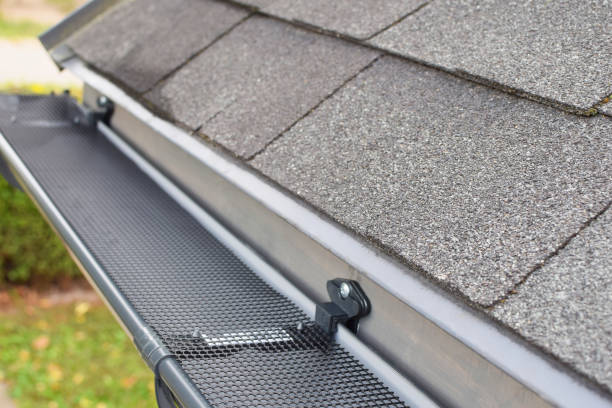
Front edge engagement: The forward edge of the guard frame is engaged under the front lip of the gutter channel — or positioned at the correct angle relative to the gutter edge depending on the specific guard system. The front edge engagement is the most consequential single step in the installation — guards that sit too far back leave a gap at the front edge that debris exploits immediately. Guards that overhang too far create an aesthetic issue and can direct water over the gutter edge rather than into the channel.
Back edge engagement and fastening: The rear edge of the guard frame is engaged with the back of the gutter channel or the fascia edge depending on the guard system design, and fastened at appropriate intervals to maintain position under wind load, debris weight, and seasonal expansion and contraction.
Mesh coverage verification: After each section is installed, the crew verifies that the mesh coverage is complete — no gaps at section joints, no areas where the frame has flexed away from the gutter edge, no mesh that has shifted relative to the frame.
Corner transitions:
Inside and outside corners require specific guard transitions — the guard sections from adjacent runs need to meet cleanly at the corner miter location without creating gaps that debris can enter through. Quinn Gutters fabricates corner transitions that maintain the coverage continuity through every corner on the roofline.
Downspout inlet protection:
The downspout inlet location — where the gutter channel transitions to the downspout outlet fitting — is a specific guard transition point that requires attention. The guard over the inlet area needs to maintain coverage while allowing water to enter the downspout outlet. For most micro-mesh systems, this means the guard is cut and fitted precisely over the outlet rather than a generic section that may leave gaps at the edges of the outlet opening.
Phase 4: Post-Installation Testing
After guard installation is complete, Quinn Gutters runs water over the guard surface on each run to verify:
Water entry into the channel: Water should flow through the micro-mesh and enter the gutter channel — not sheet off the front of the guard or pool on the guard surface. If water is sheeting over rather than entering, the guard pitch or positioning needs adjustment.
Downspout flow: Water entering the channel through the guards should reach the downspout outlets and discharge normally. Any restriction in downspout flow that wasn't present before installation indicates an installation issue at the outlet transition.
No gaps at edges or corners: Visual inspection of all edge and corner locations after water flow confirms whether any gaps are allowing water to bypass the guard and enter the channel at an unprotected location.
Phase 5: Realistic Expectations for Guard Performance in DFW
Setting accurate expectations at the conclusion of the installation is part of Quinn Gutters' professional commitment to homeowners:
What guards will do:
Dramatically reduce the frequency of gutter cleaning required — from 3 to 4 visits per year to once-annual inspection and light maintenance for most DFW properties with moderate to heavy tree coverage. Reduce the between-visit overflow risk that causes the most consequential drainage failures during spring storm season. Extend the service life of the gutter system by reducing debris weight accumulation and standing moisture that accelerate corrosion and hardware fatigue.
What guards won't do:
Eliminate all maintenance. Fine organic material — pollen, shingle grit, the finest fraction of live oak and cedar elm debris — accumulates on the guard surface over time and benefits from annual cleaning to maintain flow capacity. Annual inspection and cleaning remains the recommended maintenance practice even with quality guards installed.
The first rain:
The first rain after guard installation is an important observation opportunity. Watching how water flows over and through the guards during the first actual rain event confirms installation performance in real conditions. Quinn Gutters is available for any post-installation concerns during the first rain season.
Quinn Gutters Guard Installation Across the Full DFW Service Area
Quinn Gutters installs gutter guards throughout Fort Worth, Southlake, Keller, Colleyville, Grapevine, Trophy Club, Flower Mound, Highland Village, Lewisville, Frisco, Richardson, Plano, Allen, McKinney, Wylie, Rowlett, and every community across the DFW metroplex — with the product selection, installation precision, and post-installation testing that produces guard systems that actually perform.

Ready to Reduce Your DFW Gutter Maintenance Burden?
Request your free gutter guard assessment from Quinn Gutters today and find out whether guards are the right investment for your North Texas property — and exactly what the installation process looks like.


