
our Blog
The North Texas Homeowner's Complete Foundation Protection Checklist
Foundation protection is the single most important property maintenance priority for homeowners in the DFW metroplex — not because foundation problems are inevitable, but because they're expensive when they happen, and because the most significant risk factors for DFW foundation damage are directly within the homeowner's control through proactive drainage management.
Expansive clay soil underlies most of the DFW metroplex, including communities from Fort Worth, Southlake, and Keller to Flower Mound, Lewisville, Northlake, Weatherford, Aledo, and every community in between. This soil expands when wet and contracts when dry — producing the movement that causes foundation cracking, settling, and the expensive repairs that follow. The magnitude of that movement is directly related to the magnitude of moisture swings the soil experiences. And the moisture management practices of the homeowner are one of the most significant factors determining how large those swings are.
This checklist covers every action DFW homeowners can take to protect their foundation — with gutters and drainage at the center of the picture, and every related practice that supports them.
Checklist Section 1: Gutter System Performance
□ Gutters are clean and flowing freely.Clean gutters that drain completely after every rain event prevent the overflow that delivers concentrated roof water to the foundation zone. In DFW, this means professional cleaning at minimum twice per year — late spring and late fall — with additional frequency for properties with heavy tree coverage. Foundation experts consistently cite clean, functional gutters as the first and most cost-effective foundation protection measure available.
□ All joints and connections are sealed and leak-free.Leaking joints at the rear of the gutter channel direct water against the fascia and potentially behind the siding adjacent to the foundation. On sectional systems, inspection and resealing of any failed joints prevents this invisible moisture delivery. On seamless systems, corner and outlet connections deserve periodic inspection.
□ Gutters are properly pitched and drain completely.Standing water in the gutter channel indicates a pitch problem. Gutters should drain completely within a few hours of rain ending. Flat or back-pitched sections require pitch correction — otherwise they maintain continuous moisture contact with the fascia and add weight stress to hardware.
□ Hardware is secure throughout each run.Sagging gutters indicate hardware failure. Any sections that have sagged or separated from the fascia need to be resecured to restore drainage performance and prevent fascia damage from water contact.
Checklist Section 2: Downspout Discharge Management
□ All downspouts discharge at least 6 feet from the foundation.This is the minimum recommended discharge distance for North Texas clay soil. Every downspout currently terminating within 18 to 24 inches of the foundation is delivering concentrated roof water directly to the foundation zone with every rain event. Foundation engineering guidelines for DFW specifically cite adequate downspout discharge distance as a primary preventive measure.
□ Discharge points direct water away from the foundation.Downspouts that discharge at adequate distance but onto surfaces that slope back toward the foundation are delivering the problem to the foundation with a slight delay. Confirm that the ground at and beyond each discharge point slopes away from the structure.
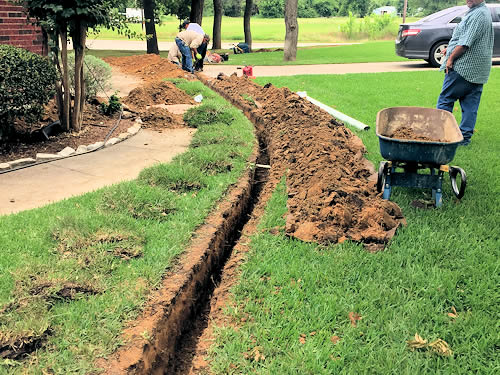
□ Underground extensions are installed where surface discharge is inadequate.For homes where surface conditions make adequate discharge distance difficult to achieve — tight lots, hardscaped perimeters, landscaping that channels water back toward the house — underground extensions carrying water 10 to 15 feet from the foundation before discharge are the right solution.
□ Pop-up emitters at underground extension outlets are clear and functioning.At the discharge end of every underground extension, the pop-up emitter should open freely during rain events and close completely between them. Blocked or stuck emitters create backpressure that impairs the full extension system.
Checklist Section 3: Yard Drainage and Grade
□ Ground slopes away from the foundation throughout the perimeter.The basic grading standard for foundation protection is a 6-inch drop over the first 10 feet from the foundation — enough grade to prevent water from pooling against the structure during rain events. Soil that has settled flat or toward the foundation over time needs regrading.
□ No persistent standing water in the yard adjacent to the foundation.Yard areas that consistently hold water for 24 to 48 hours or more after rain events are delivering that water to the foundation zone through soil migration. French drains, catch basins, or surface drain systems should be assessed for these areas.
□ Landscape beds adjacent to the foundation are properly graded.Landscaping changes over years of homeownership — added soil for plants, mulch accumulation, root system changes — can create subtle grade changes that direct water toward the foundation. Periodic assessment of landscape bed grades adjacent to the foundation identifies these issues before they accumulate into significant moisture delivery problems.
□ Mulch is maintained at appropriate depth.Excessive mulch accumulation against the foundation face retains moisture and maintains extended contact between wet soil and the foundation surface. Maintain mulch at 2 to 3 inches depth and keep it from direct contact with the foundation.
Checklist Section 4: Tree and Vegetation Management
□ Large trees are maintained at appropriate distance from the foundation.Trees within 10 to 15 feet of the foundation — particularly live oaks, pecans, and other species with extensive root systems — extract moisture from the soil adjacent to the foundation during dry periods, contributing to the contraction side of the moisture cycling that drives foundation movement. Foundation engineers recommend maintaining large trees at 15 to 20 feet from the structure where possible.
□ No aggressive root systems are growing toward the foundation.Root systems from established trees can migrate toward the foundation over time, growing against the slab and contributing to mechanical movement pressure. If large trees within 15 to 20 feet of the foundation have been present for many years, periodic foundation inspection provides early identification of any root-related concerns.
Checklist Section 5: Seasonal Moisture Management
□ Foundation moisture is maintained during extended dry periods.North Texas summers produce the most severe clay soil contraction — the drying side of the moisture cycle. Consistent, controlled irrigation around the foundation perimeter during extended dry periods maintains the soil moisture stability that limits contraction-driven movement. A drip system or soaker hose running consistently around the foundation perimeter during summer maintains moisture without oversaturating.
□ Irrigation doesn't create oversaturation adjacent to the foundation.The opposite problem — irrigation systems or watering practices that deliver too much moisture directly against the foundation — creates the expansion side of the cycle. Sprinkler heads should direct water away from the foundation face, not against it.
Checklist Section 6: Monitoring and Early Detection
□ Interior inspection for movement indicators is performed annually.Annually walk through the home and specifically check doors and windows for sticking that wasn't present previously, walls for new diagonal cracks at door and window corners, and floors for subtle unevenness. These are the earliest detectable signs of foundation movement — and catching them early when they're minor correction opportunities is significantly better than discovering them when they're structural concerns.
□ Exterior foundation inspection after spring storm season.After DFW's spring storm season, inspect the exterior foundation surface for any new cracking, spalling, or moisture staining that suggests water is reaching the foundation face. New staining below downspout locations or along the drip line indicates drainage management is delivering water to the foundation.
How Quinn Gutters Supports Your Foundation Protection Checklist
Quinn Gutters handles every gutter and drainage element of this checklist for homeowners throughout Fort Worth, Southlake, Keller, Colleyville, Grapevine, Trophy Club, Flower Mound, Highland Village, Lewisville, Northlake, Argyle, Weatherford, Aledo, Willow Park, Hudson Oaks, and surrounding DFW communities:
Seamless gutter installation that eliminates joint failures and provides properly pitched, properly sized drainage for the specific roofline. Gutter cleaning on the schedule your property's debris load requires. Gutter repairs that address hardware, joint, and pitch problems promptly. Gutter guard installation that keeps the channel clear between service visits. Underground downspout extensions that get discharge well away from the foundation. French drains, catch basins, and drainage infrastructure that address yard and foundation-level moisture challenges.

Protect Your DFW Foundation With Complete Drainage Management
Request your free foundation drainage assessment from Quinn Gutters today and let our team evaluate every gutter and drainage element of your North Texas foundation protection plan.


