
our Blog
Underground Drainage Solutions for DFW Homeowners: Catch Basins, Extensions, and More
Underground Drainage Solutions for DFW Homeowners: Catch Basins, Extensions, and More
A properly installed seamless gutter system is the first line of defense in managing water around your North Texas home. But gutters alone don't complete the drainage picture for every property. What happens to the water after it leaves the downspout matters just as much as how it gets off the roof — and for many DFW homeowners, that "after" step is where the drainage system falls short.
Underground drainage solutions — including catch basins, downspout extensions with underground lines, and integrated piping systems — work alongside your gutter system to make sure water that comes off your roof ends up well away from your foundation, your landscaping, and your neighbor's property. For homeowners across Fort Worth, Southlake, Keller, Colleyville, Grapevine, and the broader DFW metroplex, this guide covers the full range of underground drainage options available through Quinn Gutters and when each one makes sense.
The Gap Between Gutters and Complete Drainage
Most homeowners understand that gutters collect roof water and route it to downspouts. What's less commonly understood is that a gutter system with downspouts that terminate at or near the foundation isn't providing anywhere near the protection of a system that actually carries that water away.
A single downspout can discharge hundreds of gallons of water during a significant North Texas rain event. When that discharge point is a foot from the foundation — or when it empties onto a concrete surface that slopes back toward the house — all the water collection work the gutters performed gets delivered directly to the worst possible location.
On DFW's expansive clay soil, that repeated concentrated moisture delivery to the foundation zone drives the expansion and contraction cycling that causes slab movement, cracking, and the foundation repair bills that are common throughout the metroplex. The fix is not always complex — but it does require getting the discharge point far enough from the foundation to stop that moisture cycling.
Downspout Extensions: The Simplest Solution
The most straightforward underground drainage solution is a downspout extension — a section of solid pipe (rigid PVC or corrugated plastic) that connects to the base of the downspout and carries water horizontally underground to a discharge point well away from the foundation.
A properly installed downspout extension carries roof runoff at least 10 to 15 feet from the foundation before discharging — far enough that even clay soil with slow absorption can handle the volume without saturating the foundation zone.
What a downspout extension system includes:
An adapter connecting the downspout outlet to the underground pipe. A run of solid (non-perforated) underground pipe at a slope toward the discharge point — typically 4-inch PVC or corrugated drain pipe rated for burial. A pop-up emitter at the discharge end that opens when water is flowing and closes when dry. The closed position prevents debris, small animals, and backflow from entering the system between rain events.
Downspout extensions are the most cost-effective underground drainage improvement available for DFW homes where the only issue is downspout proximity to the foundation. Quinn Gutters installs underground downspout extension systems for homeowners throughout the DFW area as either standalone projects or as part of a complete gutter installation or replacement.
Catch Basins: Managing Surface Water at the Source
For DFW properties where surface water accumulates in specific locations — low points in the yard, areas adjacent to driveways or patios, spots that consistently hold water after rain — catch basins provide targeted surface water capture that downspout extensions alone don't address.
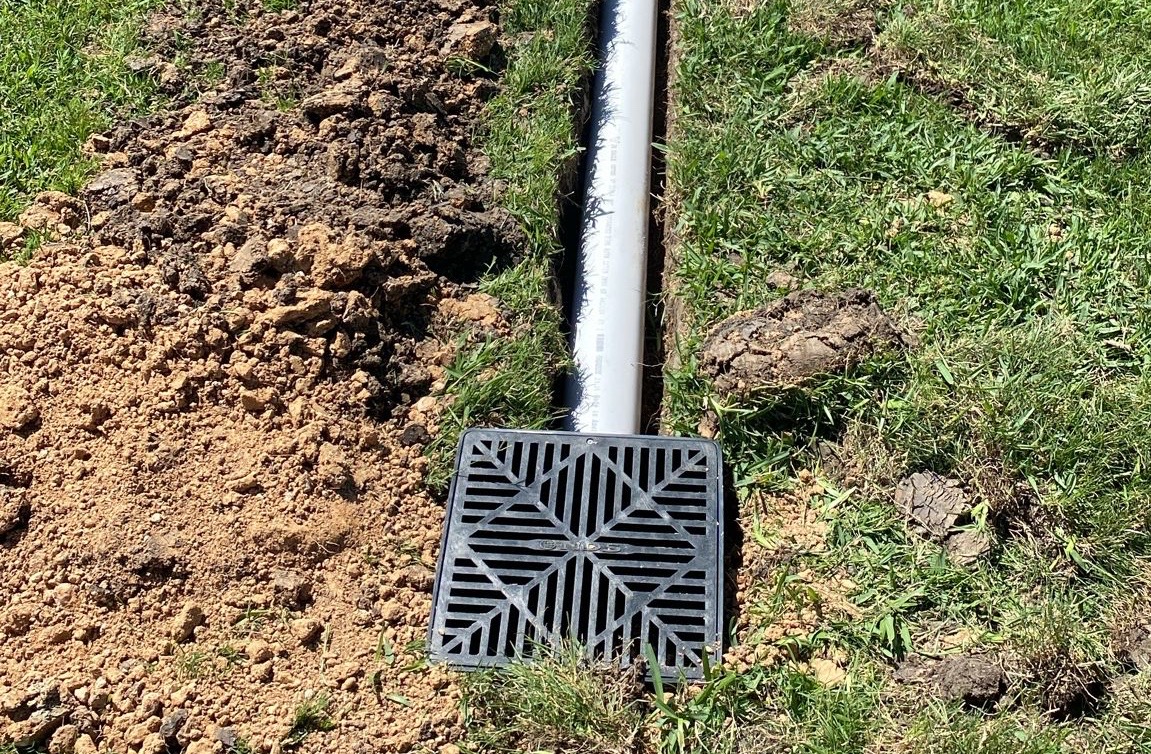
A catch basin is an underground box with a surface grate that sits flush with the ground surface. Surface water flowing across the yard or hardscaping flows into the grate, collects in the basin, and exits through a connected underground pipe routed to a street curb drain, easement outlet, or other appropriate discharge point.
Why catch basins are effective in DFW:
North Texas clay soil absorbs water slowly — which means surface water during heavy rain events doesn't drain into the ground quickly enough to prevent ponding in low areas. Catch basins intercept that surface water before it sits long enough to saturate the clay, attract mosquitoes, or damage turf and landscaping.
For DFW homeowners dealing with a backyard area that consistently holds water after every storm, a driveyard apron that floods when it rains, or a patio that drains poorly, catch basins are frequently the most direct and effective solution.
What catch basin installation includes:
Excavation at the selected collection point. Installation of a basin box sized for the drainage area being served. A heavy-duty surface grate capable of handling foot traffic and, where applicable, light vehicle loads. Connection to an underground drain line routed to the appropriate discharge outlet.
Quinn Gutters designs catch basin systems for DFW homeowners based on the specific drainage challenge at each property — determining the right basin size, placement, and outlet routing for each situation rather than applying a generic solution.
Integrated Downspout and Catch Basin Systems
For properties with both proximity-to-foundation downspout issues and surface water accumulation problems, the most complete solution connects both into a single underground drainage system.
In an integrated system, downspout underground extensions and catch basin collection points feed into a common underground drain line that routes all collected water to a single outlet well away from the structure. This design maximizes efficiency — rather than individual pipes running separately from each downspout and catch basin, a single main line handles the combined drainage volume.
Integrated systems work particularly well for DFW properties where:Multiple downspouts need to be extended away from the foundation simultaneously. Catch basins for surface water collection are being installed at the same time. The lot layout allows multiple drainage sources to route to a common discharge point with reasonable pipe runs.
Pop-Up Emitters: The Right Discharge Solution
Pop-up emitters are the surface component at the discharge end of underground downspout extensions and catch basin drain lines. They're designed to open automatically when water is flowing through the underground pipe and to close when the system isn't in use.
The closed position between rain events is critical for DFW homeowners — it prevents small animals, debris, and backflow from entering the system from the outlet end and blocking the pipe. A downspout extension that terminates in an open-ended pipe is much more likely to accumulate blockages over time than one with a properly installed pop-up emitter.
Quinn Gutters installs pop-up emitters as part of all underground downspout extension and catch basin projects — specifying the right emitter size for each application and positioning them in locations that allow water to discharge freely without eroding the surrounding landscape.
Channel Drains for Hardscaped Areas
For DFW properties with driveways, pool decks, patios, or other hardscaped surfaces where water accumulates and has nowhere to drain, channel drains — also called trench drains — provide linear surface water capture across the full width of the drainage problem area.
A channel drain consists of a linear channel set flush with the surface, covered with a grate, and connected to an underground drain line. Channel drains are particularly effective for:
Driveway aprons where water from the street and the driveway surface combines and pools at the garage entrance. Pool decks where splash and rain water accumulates and needs to drain before it creates slipping hazards or migrates toward the foundation. Patio areas adjacent to the home where surface water has nowhere to drain naturally.
When Underground Drainage Integrates with French Drains
For properties where both surface water collection and subsurface groundwater management are needed — which is common on DFW clay soil lots with drainage challenges — underground drainage systems and French drains can be integrated into a single comprehensive design.
In these combined systems, surface catch basins and downspout extensions handle above-ground water collection and routing, while French drain perforated pipe handles the subsurface moisture that saturates clay soil. Both systems can discharge through the same main line or through coordinated but separate outlets depending on the property layout.
Quinn Gutters designs these integrated drainage systems for DFW homeowners who need a complete solution — from gutter installation that handles roof water, through underground drainage that moves it away from the foundation, to French drain systems that manage the residual groundwater that North Texas clay holds near the surface.
Quinn Gutters: Drainage Solutions Across the DFW Metroplex
Quinn Gutters installs downspout extensions, underground drain lines, catch basins, channel drains, pop-up emitters, and integrated drainage systems for homeowners throughout Fort Worth, Southlake, Keller, Colleyville, Grapevine, Trophy Club, and surrounding North Texas communities.
We approach every drainage project by assessing the specific conditions at your property — where the water is coming from, where it's accumulating, and what the most efficient path is to get it well away from your foundation and out of your yard. Every solution we recommend is designed for your specific property, not a generic approach applied to every job.
Gutters and drainage work together. Quinn Gutters handles both — so DFW homeowners get a complete water management system from roofline to discharge.

Solve Your DFW Drainage Problem for Good
Request your free drainage assessment from Quinn Gutters today and let our team design the underground drainage solution your North Texas property needs.


